Animated Ads for Paid Social That Drive Tests
Animated ads for paid social give brands faster ways to test hooks, benefits, and offers. Learn how to build formats that earn attention and conversion.
By Scrolling Studio · · 6 min read
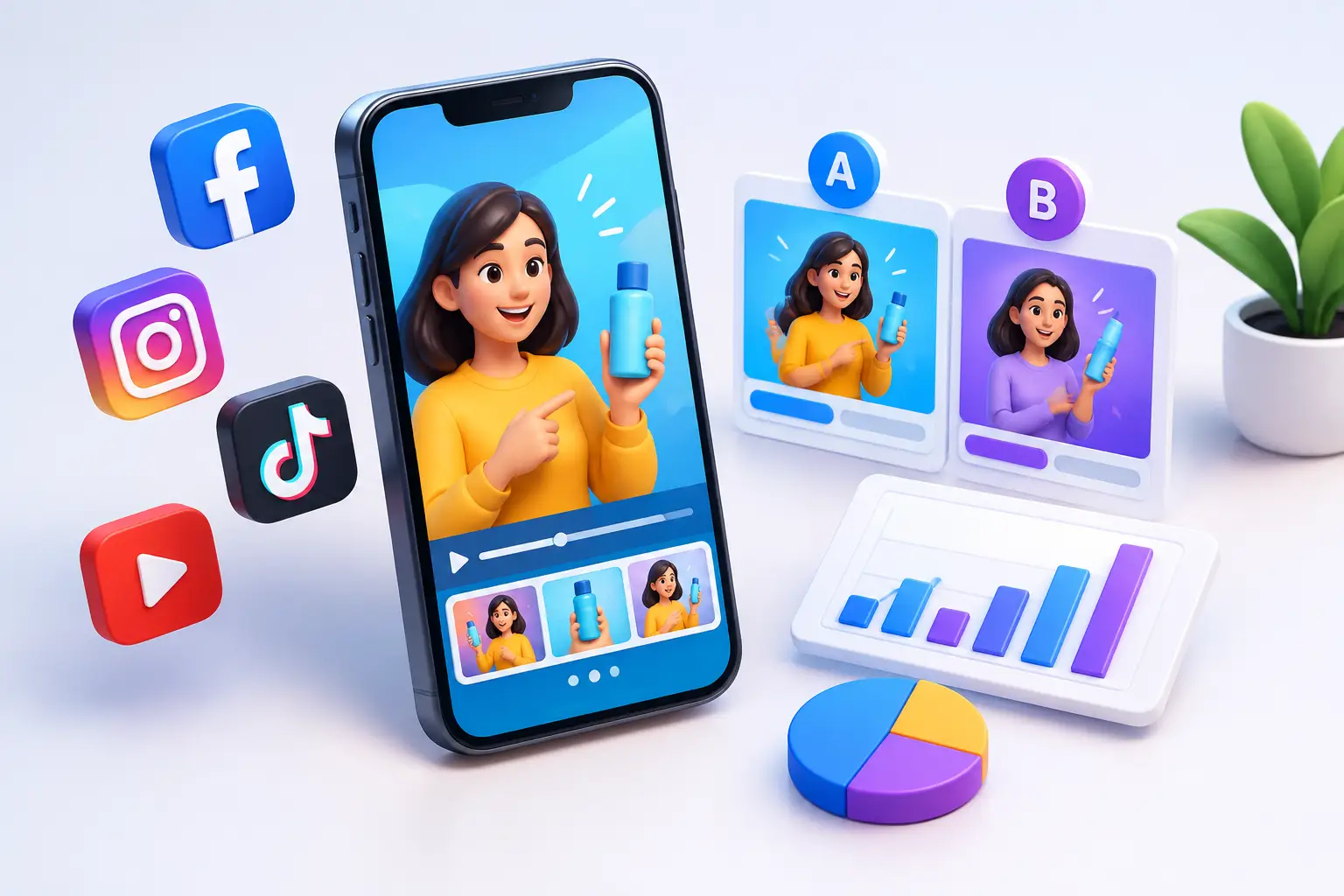
A static product image can still convert. But when the same image has been in market for three weeks, frequency is climbing, and cost per purchase is drifting up, another minor headline swap is not a creative strategy. Animated ads for paid social give performance teams a faster way to introduce a new visual pattern, communicate a product benefit, and create meaningful testable differences without planning a full video shoot.
Animation is not automatically better than UGC, founder-led video, or polished brand footage. It is another production lever. Used well, it helps brands test more angles with less operational drag. Used badly, it produces motion for motion's sake: pretty transitions, weak hooks, and no clear reason to care.
Why animated ads work in paid social
Paid social is a scrolling environment. An ad has to earn attention before it can explain value. Animation can make that first beat more legible by changing scale, isolating a product detail, revealing a problem, or turning an otherwise abstract claim into something viewers can understand in seconds.
That is especially useful when the product itself is difficult to film, expensive to stage, or more easily explained through graphics. A supplement brand can animate ingredients and outcomes. An app can pair a clean UI recording with callouts that show the before-and-after workflow. A skincare brand can use motion to demonstrate a routine, texture, or product comparison without relying on a generic stock-video setup.
The advantage is control. Every element can be designed around the message: what appears first, what stays on screen, how the offer enters, and where the viewer's eye goes next. That makes animation a strong format for testing positioning, not just visual polish.
It also has a practical production advantage. When a campaign needs fresh concepts quickly, updating animated graphics is often simpler than coordinating a reshoot, shipping products, securing creator availability, and re-editing multiple talking-head videos. The trade-off is that animation needs a sharp strategic foundation. If the brief is vague, a fast format will only deliver vague ads faster.
Start with a testable message, not a motion style
The first decision should not be whether the ad looks like kinetic typography, 3D product animation, a collage, or a slick explainer. Start with the question the ad is meant to answer.
For example, a DTC brand might need to learn whether customers respond more strongly to a problem-led hook, a proof-led hook, or an offer-led hook. An app marketer may want to test whether time savings, ease of use, or a specific feature drives more trial starts. Those are strategic differences. Changing the color of a headline or the speed of a transition is rarely enough to create a useful result.
A good animated concept has one dominant promise. It can support that promise with product visuals, social proof, feature demonstrations, or an offer, but the viewer should not have to decode the point. If the first three seconds say, "Still paying for two separate tools?" the next sequence should immediately show how the product replaces them. Do not open a problem, then spend five seconds on decorative logo movement.
For each concept, define four elements before production begins:
- The audience or use case the ad speaks to
- The hook that creates immediate relevance
- The proof mechanism that makes the claim credible
- The action the viewer should take now
That structure works whether the output is a 10-second TikTok placement, a 15-second Meta Reel, or a motion-led Story ad. It also prevents the common mistake of making one long animation and cutting it into several near-identical versions.
Build animated ads for paid social around distinct angles
The strongest creative pipelines do not treat variation as a change in caption copy. They create multiple executions with a different reason to stop, watch, and convert.
One animated campaign for a hydration brand, for instance, could test a performance angle, a convenience angle, and a taste angle. The performance version might open with the cost of an afternoon energy crash. The convenience version could show how the product fits into a commute, gym bag, and desk drawer. The taste version could use bold pack shots and flavor-led visual cues. Same product. Different customer motivation.
Within each angle, animation gives you room to test the delivery. A problem-solution sequence may begin with bold text on a plain background, then move into product proof. A product-demo execution may start with the item in use. A comparison ad may use split-screen motion to make the alternative feel obviously less effective. The key is to preserve the strategic distinction while adapting to the platform's pace.
This is why three genuinely different ads are more valuable than three versions built from the same script. If all three lose, you learn that the message may be wrong. If one wins, you know what belief or tension is worth expanding. Meaningful variation gives media buyers a clearer next move.
Design for the feed, not the presentation deck
A polished animation can fail if it follows the logic of a brand video rather than the logic of a feed. On Meta and TikTok, viewers are not waiting for an explanation. They are deciding in fractions of a second whether the first frame feels relevant.
Lead with a readable visual change or a direct claim. Keep essential text within safe zones so interface elements do not obscure it. Use large type, especially when the message carries the hook. Captions should support the visual, not duplicate a paragraph of voiceover in six-point text.
Pacing depends on the product and audience. A gaming or beauty ad can often sustain faster cuts and bolder movement. A financial product or higher-consideration purchase may need more room for clarity and credibility. Faster is not always better. The goal is controlled momentum: enough movement to hold attention, enough space for the offer to land.
Sound should be considered, but the ad must work silently. Many users will encounter it without audio, and some placements autoplay muted. Build the message so the opening, proof, and call to action remain understandable through visuals and on-screen text alone.
Use a production workflow that protects speed
Creative fatigue is not only a media problem. It is usually an operating problem. Teams run out of fresh ads because every request starts with a blank brief, passes through scattered approvals, and depends on separate vendors for strategy, design, editing, and delivery.
A better workflow starts with brand intelligence: the product, customer, current offer, existing creative, landing page, competitor context, and known performance signals. From there, translate the campaign need into a concise creative brief with defined angles, scripts, references, formats, and deliverables.
Production should then create ads as a testing system. That means planning variants at the concept level, not waiting until the final edit to make superficial changes. It also means delivering files in the right dimensions and durations for the placements you intend to buy.
Scrolling Studio is built for this model: turn a rough campaign idea into a production-ready brief and finished, owned ad creative without adding another agency process. No monthly retainer. No long contract. No agency calls.
For most performance teams, five to eight business days is more useful than an elaborate creative process that takes a month to produce one hero asset. Speed matters because it lets results inform the next batch while the campaign is still active.
Measure the signal beyond the first metric
Animated creative is often judged too quickly on click-through rate alone. CTR can be useful, particularly when comparing hooks, but it does not tell the whole story. An aggressive claim may earn clicks and still bring low-intent traffic that fails to convert.
Evaluate the ad against the campaign objective. For ecommerce, look at cost per purchase, conversion rate, and ROAS alongside thumb-stop metrics. For apps, compare cost per install, cost per trial, and downstream activation. For lead generation, watch lead quality, not just form completion volume.
Then identify where the ad is doing its job. If an execution has strong hold rate but weak conversion, the hook may work while the proof or offer needs work. If clicks are low but conversion is strong, the message might be credible but not immediately compelling enough. Those distinctions determine the next creative request.
Do not retire a winning concept just because frequency rises. Expand it. Build new hooks around the same core belief, refresh the visual device, test a new proof point, or move the offer earlier. The objective is not one permanent winner. It is a repeatable system that keeps finding the next credible angle before performance decays.
The best animated ads do not merely make the feed move. They help your team learn faster. Give every execution a job, make the differences meaningful, and let the next production batch respond to evidence rather than opinion.