Ecommerce Ad Production Service That Keeps Tests Moving
An ecommerce ad production service should create testable variations fast. See how faster briefing, production, and delivery protect paid social momentum.
By Scrolling Studio · · 6 min read
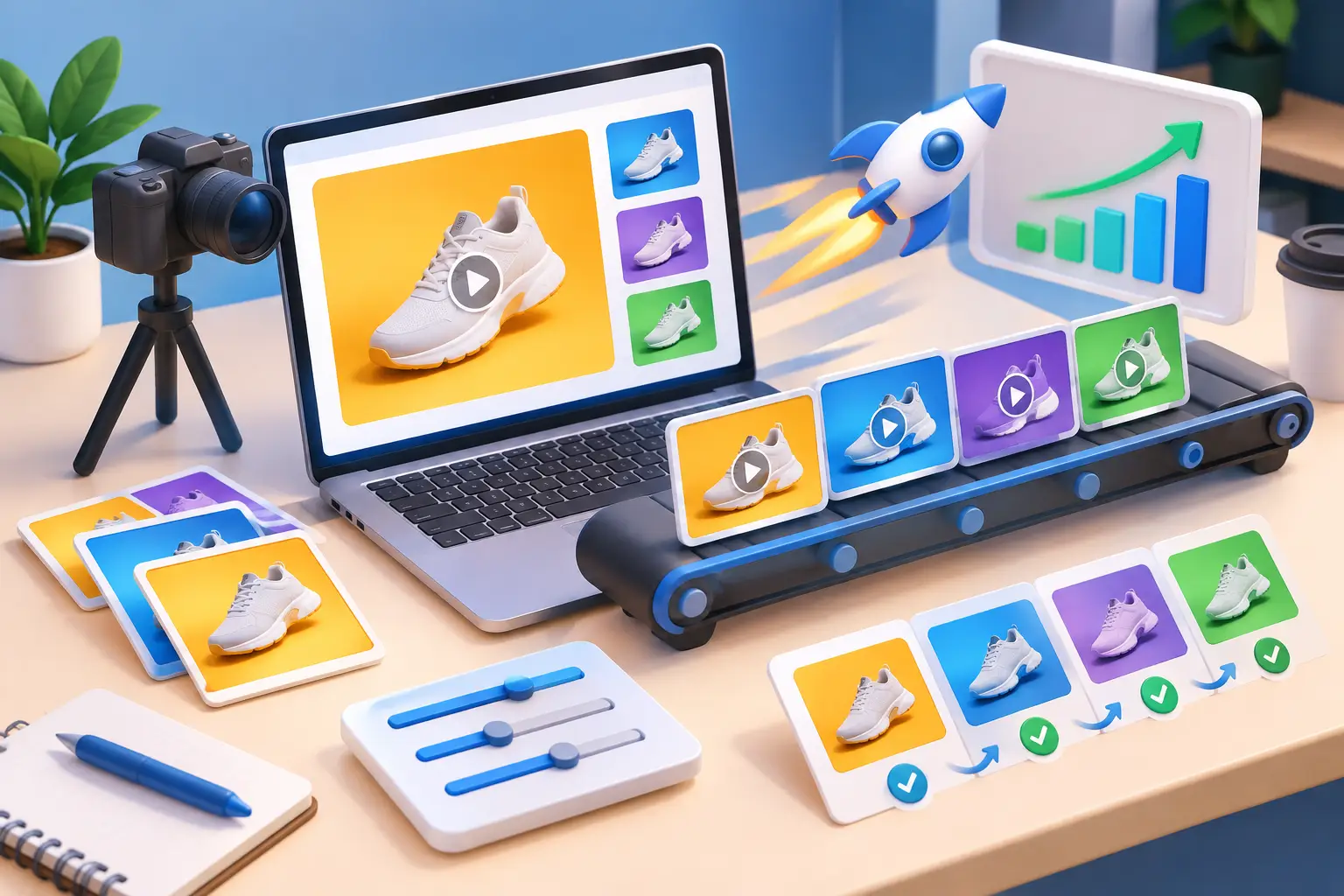
A paid social account can absorb a weak ad. It cannot absorb a stalled creative pipeline for long. When spend is increasing, winners fatigue, and the next campaign depends on a launch date, an ecommerce ad production service is not a nice-to-have vendor. It is part of the operating system behind acquisition.
The standard workflow is built for delays. Someone writes a brief from scratch. An agency schedules a kickoff. Creators are sourced, contracted, and managed in separate threads. Feedback arrives after the market has moved on. By the time assets are delivered, the original insight may already be stale.
Brands need a different production model: one that turns a campaign idea into strategically distinct, ready-to-launch ads in days, not weeks.
Why creative production slows paid social growth
Most performance teams do not have an idea problem. They have a translation problem. They know which product angle is worth testing, which objection is showing up in comments, or which audience segment needs a different entry point. Converting that knowledge into multiple usable ads is where momentum disappears.
Traditional agencies can produce polished work, but the process often carries fixed scopes, long timelines, and more meetings than a testing cadence can support. Creator marketplaces offer access, but leave the brand to manage casting, contracts, briefing, revisions, editing, and quality control. Internal teams offer brand proximity, but are usually stretched across launches, email, site updates, and a growing request queue.
Each approach can work in the right situation. A major brand platform campaign may warrant a full agency process. A founder-led product story may be best shot in-house. But neither solves the recurring need for performance creative that is built to test, delivered quickly, and refreshed before fatigue affects cost per purchase or ROAS.
What an ecommerce ad production service should deliver
The output is not simply a batch of videos. A useful service should deliver a testing system inside every order.
That begins with a brief that understands the business. Product pages, customer reviews, existing ads, brand guidelines, competitor positioning, and campaign goals should inform the concept before a creator records a word. If the brief misses the actual purchase driver, faster production only gets the wrong idea into market sooner.
Next comes meaningful variation. Three ads with the same opening line, talking points, and pacing are not three tests. They are one idea in three exports. A useful set of variations changes the thing that can affect performance: the hook, creator perspective, proof point, objection, visual structure, offer framing, or call to action.
For example, a skincare brand may test a problem-first hook about dry, irritated skin against a proof-led routine demonstration and a creator testimonial focused on simplifying a crowded bathroom shelf. The product is the same. The buyer motivation being tested is not.
Finally, the ads need to be production-ready. That means platform-conscious framing, clean editing, readable on-screen text, appropriate pacing, sound treatment, and delivery in the formats the media team can actually launch. The work is only done when it enters the account, not when it enters a review folder.
Brief once, then produce with context
A better workflow reduces repeated onboarding without removing strategic control. The brand supplies the campaign goal, product focus, and any non-negotiables. The production system uses brand and market context to shape the brief, scripts, and concepts. Human producers then manage the details that automation alone cannot handle: choosing the right creator, directing the execution, reviewing footage, editing, and running revisions.
This is where speed becomes credible rather than reckless. Fast production should not mean handing an untested prompt to a creator and hoping for usable footage. It means reducing the administrative work that adds no value while keeping the judgment calls that protect quality.
Scrolling Studio follows this model by turning rough campaign inputs into structured creative briefs and finished ads across UGC, AI-generated, AI-avatar, animated, and playable formats. The point is not to force every campaign into the same template. It is to give performance teams one place to order the format and volume that match the next test.
A product demonstration may need a UGC creator with credible delivery. A fast-moving offer test may call for AI-generated concepts that can be produced at volume. An app team may need playable units built around an interaction, not another talking-head video. The production choice should follow the hypothesis.
Build variations that generate useful answers
Creative testing gets expensive when variations are cosmetic. If an ad loses, the team should be able to say why it may have lost and what to test next. That requires intentional contrast between executions.
Start with the central claim. Is the campaign asking people to believe the product saves time, solves a frustrating problem, delivers visible results, or offers better value? Then give each execution a clear job. One can lead with the pain point. Another can lead with product proof. A third can use social validation or a specific use case.
The variables within each ad still matter. The first two seconds need to earn attention. The script needs to hold one coherent message. Visuals should demonstrate the claim rather than decorate it. The call to action should match the stage of awareness. But those craft decisions should support a testing plan, not turn every concept into the same generic direct-response script.
There is also a trade-off between volume and learning. Ten new ads are not automatically more valuable than three well-differentiated executions. If a team has limited budget, fewer ads with sharper hypotheses may produce cleaner signal. If spend is high and fatigue is frequent, a larger pipeline becomes necessary. The right answer depends on media budget, account maturity, approval speed, and how quickly the category changes.
Speed matters because creative fatigue does not wait
Creative fatigue is often discussed as a media-buying problem. It is usually a production problem first. Frequency climbs, thumb-stop performance softens, and conversions decline because the account has kept spending against a familiar message longer than it should have.
The fix is not random novelty. It is a reliable rhythm of new angles, new creators, new formats, and new proof. An ecommerce team should be able to identify an emerging need, place an order, review work efficiently, and launch the next round while the current winners still have life.
A five-to-eight-business-day turnaround changes how a team plans. Instead of waiting for a quarterly creative refresh, paid media managers can schedule weekly or biweekly testing cycles. Instead of treating every request as a production emergency, they can build a backlog of hypotheses around products, offers, seasons, and customer objections.
That pace also changes accountability. Creative strategy, production, and media performance become connected. When the team knows what was deliberately changed in each execution, it can use results to inform the next brief instead of restarting from zero.
Keep ownership and purchasing control with the brand
Retainers are useful when a team needs embedded strategic support every month. They are less useful when creative demand rises and falls with launches, inventory, seasonality, or media spend. An ecommerce ad production service should let brands buy for the campaign in front of them without committing to a long contract just to keep production moving.
One-time projects and configurable packages give teams practical control. A brand can order three 15-second concepts for a new acquisition angle, then expand the winning route into more creator-led executions. It can commission a larger refresh before a promotional period, or use a smaller set to validate a message before scaling spend.
Full ownership matters for the same reason. Paid assets may need new cutdowns, edits for another channel, updates when an offer changes, or reuse in landing pages and email. Brands should not have to renegotiate access to creative they paid to produce.
No monthly retainer. No long contract. No agency calls required to move a test forward.
Choose production around the next decision
The strongest creative pipeline starts with a simple question: what decision does the next batch need to answer? It may be whether a new audience responds to a specific pain point, whether founder authority outperforms creator relatability, or whether an offer needs more product proof before it can scale.
Give production that question, not just a request for “more ads.” Ask for executions that make the answer clearer. Launch them with enough budget to learn, document the result, and use that knowledge in the next brief.
The brands that sustain paid social performance are not the ones waiting for one perfect ad. They are the ones that can keep producing the next informed test while their competitors are still scheduling the kickoff call.